
Hail damage roof inspection,done like evidence.
Verify the storm, photograph the soft metals, work the slopes, then classify every image — damage class, severity, confidence, and a written note — so the file holds up in the first review instead of the third.
Five steps, in this order.
Confirm a storm actually hit
Before anyone climbs, check the address against verified NOAA hail and wind events — date, distance, reported stone size. If nothing qualifies near the property, you have a maintenance conversation, not a claim.
Photograph the soft metals first
Gutters, downspouts, drip edge, vents, HVAC fins, and the mailbox. Round dents on soft metals are the cleanest proof of stone size and direction, and they are visible from the ground.
Work the slopes elevation by elevation
Shoot each elevation wide, then close on the impacts. A test square per slope shows density. Ridge, hips, valleys and every penetration get their own frames.
Classify each photo, don't eyeball the roof
Every image is read individually and returns a damage class, severity, a confidence score, and a written inspection note. Findings under 50 confidence are discarded before they reach the report.
Ship one document
Photo evidence, verified storm history, building-code support, measurements and the scope on a single file — instead of three unrelated PDFs and a text thread.
Hail reads differently on every material.
Asphalt shingle
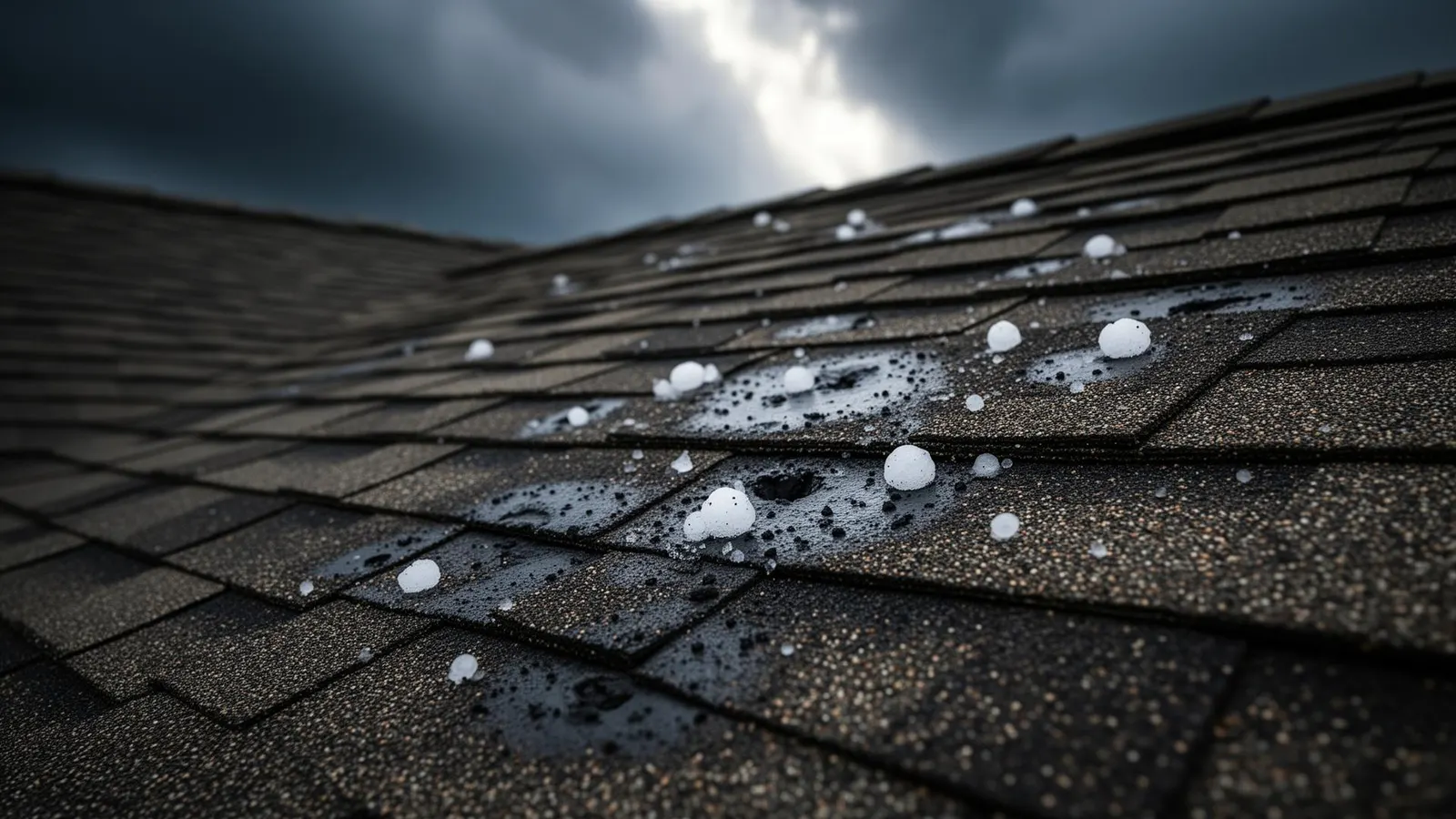
Random-pattern bruises with granule loss, a soft mat under thumb pressure, exposed black substrate. Hail does not follow the shingle lines — that pattern is mechanical or wear.
Soft metals
Round dents in gutters, downspouts, drip edge, vents and turbine caps. Dent size and the elevations hit establish stone size and storm direction.
Tile
Chipped edges, hairline cracks radiating from an impact point, and broken tile at the field. Damage is often only visible with a close, direct frame.
Metal panel
Dimpling across the pan and dents at the ribs. Cosmetic exclusions frequently apply, so documentation of coating fracture matters more than dent count.
Wood shake
Fresh splits with sharp edges and impact marks free of weathering. Old splits are gray through the break; hail splits are bright.
Flat / modified
Bruising in the cap sheet, displaced granules, and fractured surfacing over insulation. Ponding areas hide hits — photograph after they dry.
Hail inspection questions.
How do you inspect a roof for hail damage?+
Verify a qualifying storm event for the address and date of loss, photograph the soft metals from the ground, then work each elevation with wide shots followed by close frames of every impact, including a test square per slope. Photograph ridge, hips, valleys, and all penetrations. Then classify each photo — damage class, severity, confidence — instead of writing a single subjective verdict about the roof.
What does hail damage look like on a roof?+
On asphalt, a random-pattern impact with granule loss and a soft, bruised mat. On soft metals, round dents. The key word is random: hail ignores shingle courses and traffic paths. Anything running in a line, clustered around HVAC, or uniform across every slope is mechanical damage or wear, not hail.
How long after a hail storm can you file a claim?+
Most policies require prompt notice and many states set a hard filing window measured from the date of loss — commonly one to two years, but it varies by state and policy. The practical answer: verify the storm date first, because the date on the report is what the carrier measures from.
Can hail damage be missed on an inspection?+
Routinely. Bruising is easy to walk past in flat light, and the soft metals that prove stone size are often never photographed. Classifying every image individually — instead of forming an impression from a folder — is what catches the hits a fast inspection loses.
Do I need a drone for a hail inspection?+
No. Phone photos taken on the roof work, and drone or aerial imagery works too. Photos are normalized before analysis, so mixed resolution, oblique angles and imperfect light are fine.
What proves the hail caused the damage and not age?+
Verified storm events for the property coordinates on or near the date of loss, matched with directional evidence on the roof — dented soft metals on the same elevations as the shingle impacts. Wear is uniform and unrelated to any storm date; that contrast is the argument.